Showing posts with label Review. Show all posts

Tuesday, 2 April 2013

Review: Jostein Gaarder's "Sophie's World"

Norwegian writer Jostein Gaarder is undoubtedly an ambitious writer. It's a brave man who will attempt to marry a brief history of the entirety of Western Philosophy with a mystery novel when there is so much to fit in without running the risk of trivialising some of the most profound thoughts mankind has ever been able to come up with.


And does he achieve it? Well... no, not at all actually. Now don't get me wrong, Gaarder does an impressive job of explaining Plato and Satre in an accessible way but the problem is in order to do it properly it takes up a lot of space which doesn't leave much room for character development. Around about the halfway mark events start to take on a more serious tone as the mystery behind why an old man chooses to impart Sophie with his knowledge of philosophy begins to be solved but because there has been very little time spent with either Sophie or her teacher it's very difficult to sympathise with either. To make matters worse Sophie herself becomes something of an irritation when the lessons go from written to verbal and she has to keep interrupting with what can sometimes be rather inane comments.

It also doesn't help that Sophie's character is not established at all before the mysterious letters through which her course begins arrive. We are unable to appreciate how much the new ideas she is being introduced to influence her behaviour because we have no idea what she was really like. Her teacher, Alberto Knox is just as underdeveloped but this is less of an issue as his role is more of a facilitator for Sophie's growth rather than a focal point himself. There is actually a reason why Gaarder may have felt such paper thin characters were necessary (which I can't discuss without ruining the twist) but even with this excuse (and it does feel like an excuse rather than an explanation) the fact is that other writers have tackled similar ideas with far more success.

Once the twist is revealed the novel yet again disappoints by using its concept in a mostly superficial manner and in the most obvious ways possible. It is a novel almost completely devoid of subtlety, particularly in its execution but also in its language as well. At times it reaches for a sort of philosophical depth but instead settles for cheap tricks which don't really add much to the narrative and the sort of boomingly hollow platitudes you would expect to see on bumper stickers and the faux inspirational posters that seem to be doing the rounds on Facebook again for some reason. A whole chapter early on can basically be summed up as "Live every day to its fullest" but is presented as if it is some great truth which nobody in the modern world can appreciate. Sadly I am not exaggerating. It is so saccharine in places as to convince the reader of the very real threat of potential transmission of diabetes through literature.

I am disappointed that with what could potentially have been a very solid basis for a good book Gaarder has shot so wide of the mark. Instead of creating a harmonious mix of all the different elements what we are left with feels more like a child has tried forcing bits from three different puzzles together. It doesn't work at all and my only recommendation is if you are really desperate for a beginner's guide to philosophy you can flick through in a few days.

Rating: 3/10

Friday, 15 March 2013

Review: A. S. Byatt's "Possession: A Romance"

Something worth noting: A. S. Byatt's "Possession" has turned out to be a difficult novel to review for me mostly down to the fact that I fit into its target audience almost perfectly and so my enjoyment (and I REALLY enjoyed this book) might very well be coloured by that fact. Sure all reviews are basically just opinion and that is going to be true of anything I write to a certain extent but it's such a factor here that I thought it best to come clean from the get go. Suitably warned? Brilliant. Let's dive in then.


"Possession" is based in the world of literary academia with the discovery of an unfinished letter leading to a potential connection between two major (and fictional) poets of the Victorian era thought to previously be entirely at odds with one another due to their vastly different approaches to writing. As the two scholars involved attempt to unravel this previously unknown relationship they find their own dealings with each other coming to mirror the very events they are investigating. This treats us to two parallel story lines, each simultaneously complimenting and satirising the other.

Byatt has managed to capture the spirit of Victorian romance novels in the past of the two poets including all the melodrama and colourfully passionate language that you would expect from somebody like the Brontes with a smattering of D. H. Lawrence thrown in (though thankfully not too much). The contrast between this and the highly analytical approach in the modern sections is both what may intrigue and may put people off. 

As with Umberto Eco, Byatt has no problem with going into detail about various literary theories and philosophical questions when the need arises so in places the prose can get quite dense. If that doesn't scare you though it really adds to the richness of the two narratives by engaging you directly with the kind of thought processes that are whipping through the character's minds. It is ultimately a novel about relationships, and the possessiveness that sometimes creeps in, both in romantic ones and the relationships between a scholar and their subject. Having the kind of detailed insight which Byatt provides makes a great deal of difference when attempting to understand the sometimes seemingly illogical steps the characters chose to make.

What "Possession" manages so well is the balance between the intellectual and the emotional elements of the stories. There are clearly criticisms being made of the academic world and its treatment of its subjects but never does this overshadow the importance of the characters and their development. All this is backed up by evocative language rich in sensuality and appropriately tweaked according to the varying effects Byatt is trying to create. I especially recommend this to anybody who has done an English degree because you'll definitely recognise some of the issues brought up.

Rating 9/10

Tuesday, 5 March 2013

Review: Barbara Kingsolver's "The Poisonwood Bible"

I will admit to a certain amount of scepticism when approaching this book. The plot surrounds a missionary and his family moving to the Congo in order to spread the word of God to the natives but during their time there they quickly realise that their rigid values and assumed superiority does not hold up too well in the jungle. Whilst there is nothing inherently wrong with the set-up it made me nervous because such stories have a horrible habit of descending into the "noble savage" worship that you've probably seen in movies like "Dances with Wolves" or "The Last Samurai". I love learning about other cultures and part of that is learning about what they do better than our own but at the same time the rose tinted glasses are firmly in place a lot of the time and the end result ends up being either blinkered or downright patronising. So does Barbara Kingsolver manage to dodge the pitfalls in "The Poisonwood Bible"? The answer is a resounding yes.


What Kingsolver manages so well in this novel is its examination of prejudice and what is "natural". The exploration of the villagers' views on disability is particularly memorable and gives a fascinating counter-point to the way it is treated here in the West. On the flip-side the way gender is treated in the Congo is obviously a major problem and this is highlighted by the difficulties the women of the family have to overcome during their stay. In fact gender plays a massive role in "The Poisonwood Bible" because the father is the only male member of the Price family and significantly the only of the six of them to never have a first person narrative section. Politics, religion and culture are all subjected to close scrutiny and the overall effect is a very balanced one rather than the one sided polemic which could so easily have been.

As already mentioned the entirety of the novel is told through a first person perspective but the character whose perspective it is changes from chapter to chapter. This is an approach which works brilliantly in providing us with multiple interpretations of the same events as viewed by very different people. Each of the daughters has a distinct voice and set of values and desires. Contrast is the name of the game and Kingsolver has a deep understanding of how to use this to her advantage. This particularly evident when an army of driver ants attacks the village and the family is forced to flee until they have passed through. The differing experiences of all those involved gives a richness to the event and its consequences which might otherwise have slipped away.

The feature which elevates the novel from a good one to a brilliant one though is its playful use of language. The sections written from the perspective of the disabled twin Adah are especially good as the damage done to her brain in the womb has affected her perception of words and she toys with them, reading forwards and backwards and really grasping the potentially confusing language the villagers use in all its idiosyncrasies. Most words have multiple meanings and inevitably this causes misunderstandings that are simultaneously humorous and very telling of the disconnect between the preacher and his congregation.

My only real issue with the novel, and the only thing which prevents me giving my first 10/10 is that it loses a bit of its steam in the last 150 pages or so because of certain changes which make the narrative less visceral and immediate. Though probably necessary considering the story Kingsolver wants to tell this later section just isn't quite as good as the rest but I still thoroughly recommend "The Poisonwood Bible" as a great read.

Rating: 9/10

Monday, 25 February 2013

Review: John Boyne's "The Boy in the Striped Pyjamas"

Here's the set up. The tragic story of the atrocities committed in Auschwitz told through the eyes of a child who was there. Sound interesting? Well maybe but there have been countless attempts to capture the events of the Holocaust in literature and film. As a historic event it is probably one of the most difficult topics to express the world has ever seen and is understandably why so many artists feel the need to attempt it. The problem is with so many of the world's best writers tackling it how can anybody say something new about the Holocaust? Well perhaps by viewing it from a different perspective. The child in question is not a little Jewish boy imprisoned in the camps. Bruno is the son of the man running Auschwitz.


Boyne's choice of narrative focus lends itself to some potentially interesting conflicts between the inherently questioning nature of a child and the adults around him who are blinkered by Nazi ideology. It uses Bruno's friendship with a young Jewish prisoner as a way of demonstrating how racial hatred is something which must be instilled rather than being instinctive and "natural". A worthwhile message which still remains relevant in today's post 9/11 age.... which is why I feel somewhat guilty to have to tear into this novel in the way I'm about to.

Despite it's good intentions and interesting set up "The Boy in the Striped Pyjamas" feels very much a novel by numbers. Strict and often absent father figure: Check. Vindictive young Nazi officer being unnecessarily brutal in his treatment of people/animals: Check. Ditzy sister obsessed with being pretty and attracting young men in uniforms: Check.

Everything from the characters to the set pieces could be predicted before you got through the first page and in a work which is attempting to encompass the needless cruelties of the Holocaust this is a severe failing. It becomes impossible to really empathise with the situation when everything feels like it was all assembled with instructions taken from a flat-pack wardrobe. There are no real defining moments. Think of every book you've ever loved. Think of all the small details which create the richness of your favourite characters. That is what's missing. It isn't technically "bad" in anyway but the overwhelming blandness leaves you with the sensation of chewing soggy cardboard, the lack of flavour forcing you to focus on the unpleasant texture. 

This is not to say that it is entirely devoid of merit. The ending is well constructed and would be rather poignant if the characters were better fleshed out and there is a moment where Bruno discovers one of his servants used to be a doctor which is cleverly worked. Sadly though they just serve to highlight how good a novel "The Boy in the Striped Pyjamas" could have been.

Rating: 5/10

Monday, 18 February 2013

Review: John Kennedy Toole's "A Confederacy of Dunces"

A confederacy of dunces is the term Jonathan Swift once used to describe the idiots who congregate around genius in order to tear it down, a conspiracy of stupidity which must inevitably swarm around all those of supreme talent and intellect because the unenlightened cannot possibly hope to understand true greatness and thus seek to destroy it instead. If that all sounds slightly pompous and arrogant to you then you'd be thinking exactly like John Kennedy Toole was when he titled his novel about a more than slightly pompous and arrogant man named Ignatius J. Reilly.


As you probably already suspect (or indeed know) "A Confederacy of Dunces" is a humorous novel that details the inevitable misadventures of its gloriously deluded central character as he attempts to overcome what he sees as the mental and moral ineptitudes of the world around him. Due to sudden financial hardship the thirty year old, overweight, college-grad unemployed layabout has to get a job except that involves working for the very people his despises at the bottom rungs of the corporate ladders because he has done nothing but sponge off his poor at-the-end-of-her-tether mother since he finished his masters.

This is all a perfect set-up for a series of preposterous events involving, amongst other things, a party with its own sex dungeon, a stripper being undressed on stage by a parrot and a policeman hiding in a toilet dressed as a cowboy. Ignatius acts as a catalyst, bumbling through the French Quarter of New Orleans and triggering one insane scene after another.

The problem with writing comedy though is that it can be really difficult to get right on the page. On screen or on stage something can be imbued with humour by the actor's sense of timing and voice but in the written form all this has to be successfully conveyed through the readers imagination. It's a really hard trick to pull off and in order to manage it a writer has to create an exceptional narrative voice you can hear in your head as you read (see Douglas Adams or Terry Pratchett) if there is any hope you genuinely laughing aloud whilst reading.

Fortunately it is a trick which Toole has nailed, thanks in most part to the convincing ridiculousness of his protagonist. The novel regularly gives us insight into Ignatius's own interior monologue as well as access to some of his letters and personal writings which adds to the multi-layered farcical flavour whilst providing the opportunity to take clever pot shots at American life in the sixties. A wonderfully entertaining book for all fans of self-indulgent American comedy. 

Rating: 9/10

Friday, 15 February 2013

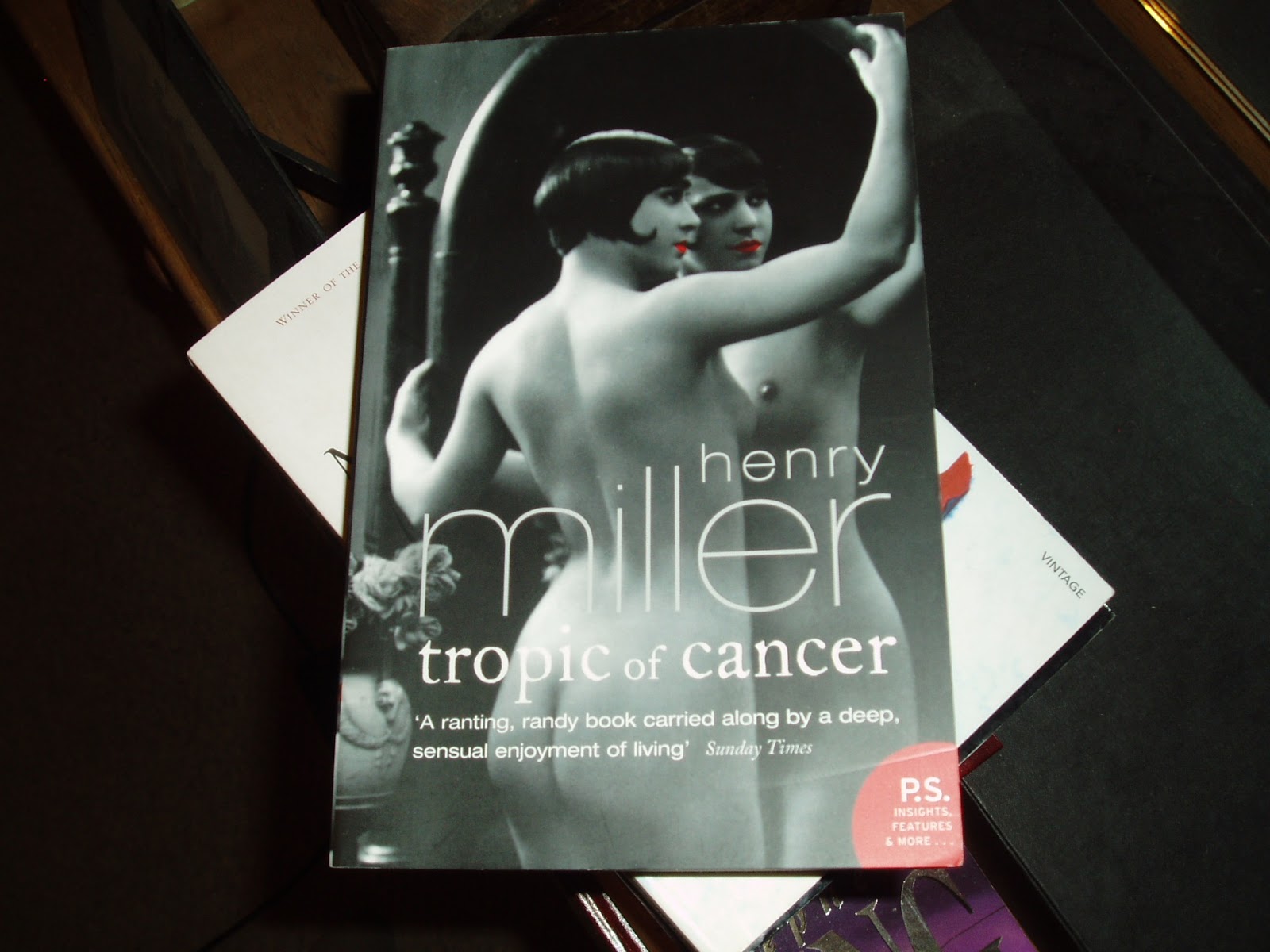
Review: Henry Miller's "Tropic of Cancer"

When looking for a book to read I like to find one which caused a bit of a stir when it was released. If it offended some people, got banned in a few countries and generally split the critics right down the middle, half saying it was genius the other half claiming it was depraved I want to read it. This is partly due to the normal "I want to see why everybody's getting so angry" reaction but also because I find books that really divide people are the ones which you end up loving the most or hating the most. "American Psycho", "The Wasp Factory" and "The Satanic Verses" are among my favourite books of all time and they all caused an uproar at the time they were released. So, naturally, when I saw that similar allegations of perversion and moral degradation were being made of Henry Miller's "Tropic of Cancer" I was intrigued but with it being written in 1935 I was dubious as to how bad it could be.


Truth is, by today's standards, it has become somewhat tame. Not in an "aww look at the pretty kitty" kind of way but it's not exactly a lion liable to tear your throat out at any given moment either. Think more along the lines of a stray cat who might enjoy some fuss and attention one minute and then claw the hell out of your arm the next. Those with thick skin will find the novel's sexual talons and its four letter fangs barely scratch the surface but anybody who is a little squeamish when it comes to sex and graphic descriptions of body parts probably won't enjoy this one.

If you haven't been put off yet though I suggest you give Miller a chance because he is a literary craftsman, a stylist who embodies some of the best traits of the Modernist tradition, fusing "artistic" and "vulgar" language in a virulent manner that infects the reader and leaves you stumbling through his scenes like you're in a fever dream. 

The plot (well as much of a plot as there is) follows Miller himself in a semi-autobiographical romp through the highs and lows of Paris. Each chapter details a different episode in his adventures, slipping in and out of stream of consciousness style, which are in turns amusing, sordid and depressing as he struggles to make a living whilst clinging to the vain dream of being a novelist. The supporting cast range from prostitutes to fellow would-be, self indulgent artists to the rich and well connected and they all flow in and out of the protagonist's life like driftwood rushing through a turbulent river.

If a coherent story about a likeable character who struggles against adversity is your cup of tea then "Tropic of Cancer" isn't for you. Miller comes across as a manipulative scrounger who doesn't really give a damn about any of the people in his life and most of the other characters are just as despicable. It is a "warts and all" depiction of what life would have been like at the time and can get very unpleasant at times but ultimately it is the richness of the prose that continues to give this novel its classic status and it is on this basis that I highly recommend any fans of James Joyce, Samuel Beckett or Virginia Woolf  who are not easily offended to give it a try.

Rating: 9/10

Tuesday, 12 February 2013

Review: Joe Haldeman's "The Forever War"

It's science fiction time folks and for my first review in the genre I picked one of the classics, a name included in the SF Masterworks series and a book I've had recommended to me several times. "The Forever War" by Joe Haldeman.

Haldeman wrote this in the mid-seventies, just after the big science fiction boom which saw Isaac Asimov, Philip K. Dick, Robert Heinlein and Arthur C. Clarke rise to fame. The euphoria of the space race had begun to lose its momentum and the Vietnam war was coming to a halt as American troops steadily pulled out. As such the optimism which was often embodied by the science fiction genre previously (particularly in Asimov) is absent and instead we are treated to a cold and brutal imagining of what warfare might be like in the future for those expected to take part.


The plot centres on a physics student turned soldier named William Mandella, conscripted into the armed forces because of his exceptionally high IQ. It follows his experiences through dangerous training exercises and war against an unknown alien race but it's real hard hitting moments are the quiet periods in between campaigns where he is forced to live in a society he no longer recognises.

The key premise of the novel is that due to relativity time passes differently for those travelling in hyper-space  than it does back home and as such whilst only a year may go by for Mandella back home decades have gone by. The longer the campaign goes on the more and more removed he and his fellow soldiers become from the world they are trying to protect. It is a brilliant metaphor for the dislocation felt by veterans at the time (Haldeman himself being one) and the novel gives plenty of space over to exploring the various different possibilities and effects it might create.

There is a problem, however. Whilst the ideas and the scenarios which Haldeman creates are brilliantly realised with all the detail you could want the characters themselves are a little flat in places. It is not a very long book and there simply isn't room within its pages for everything such a complex story demands. Unfortunately the character development suffers for it. That isn't to say the characters are terrible. In places they can very good in fact but it happens too rarely for such a psychologically invested premise. The ending is also a little rushed feeling and doesn't seem to quite suit the overall feel of the novel.

All that said though this is still a novel that deserves your time, especially if you like your science fiction to be socially conscious and with a slight satirical bite to it.

Rating: 7.5/10

Thursday, 7 February 2013

Review: Umberto Eco's "Foucault's Pendulum"

I want to get something out the way early on with this one. "Foucault's Pendulum" was published in 1988, twenty five years ahead of Dan Brown's ridiculously popular mystery thriller "The Da Vinci Code" so that when I say "this novel is about conspiracy theories involving the Templars, the Illuminati, the Rosicrucians and the Holy Grail" your first thought isn't "didn't somebody already do that?" That isn't all though. Not only did Umberto Eco write a vastly superior novel a quarter of a century ahead of Brown but it's a spoof, a cleverly constructed jab at the world's century-spanning obsession with conspiracies involved the Knights Templar.


You've probably already twigged that Dan Brown isn't my favourite author. I'm not going to go into that though because a) it's boring because everything that can be said about it has already been said and b) I'd like to think nobody cares anymore. It does, however, have relevance to this review because I have to admit a lot of my enjoyment of the novel was due to the way it mercilessly skewers the credulous nature of people who want to believe these stories and as somebody who was sick of hearing about how "it really could be like that" at the time I really found myself wishing I'd read this eight or nine years earlier.

The novel follows the story of three editors in a cynical "vanity publishing" house getting involved in creating their own conspiracy theory as a way of mocking the lunatics and obsessives they have to work with. Things don't end up quite so simple though (as you'd expect) and Eco leads us on an incredibly detailed and beautifully penned examination of the seductive power of conspiracy theories.

Detailed is a key word here. It probably would have been easy for Eco to gloss over the more complicated bits of history in a rush to make his point but his obvious passion for the subject leaves him unwilling to do so. A large amount of novel's 640 pages is given over to detailed historical descriptions, as well as drawing in science and occultism. This is both a strength and a weakness. In one sense it is refreshing to see an author who is so confidant in the interesting nature of his subject matter really let his passion shine through. He also avoids the trap of leaving too little room left over to explore his characters but it can be a turn off for those who find history a dry subject. There are a lot of names and concepts woven throughout the narrative with an assumption that you will be familiar with them and sometimes that is not the case, leaving the reader confused.

The novel's biggest strength though is the quality of the prose. A vast vocabulary (even more impressive when you consider this is a translation) wielded by an expert to create moments of distilled character insight is always a joy to read and Eco manages to pack in plenty. The character of Belbo in particular is sublime, eliciting sympathy and  frustration in equal measure as he struggles to come to terms with their theory and what it might potentially mean to him personally.

Overall this is an impressive piece of fiction by a man who clearly understands what it means to write great prose but it does assume a rather hefty amount of knowledge from its readers and can, (rather appropriately) at times, become too bogged down in its own obsessions. Give it a try if you fancy a challenge but have wikipedia on stand-by just in case.

Rating: 8/10

Tuesday, 5 February 2013

Review: Haruki Murakami's "The Wind-Up Bird Chronicle"

Murakami is a name I've seen and heard floating around for a while. Until recently though all I knew was that he was a Japanese writer who wrote books which everybody loved, be it critics or a bloke I met down the pub and there was one novel of his which kept being mentioned. "The Wind-Up Bird Chronicle."


Hype is often a cruel force. You hear so much about how good a book is, how the style is so well polished, how interesting the concept is, the comparisons with other writers you love only to have it turn into a hideous disappointment. It's tough for any novel to live up to that kind of expectation.

Happily I get to say that this time the Hype-Machine got to trundle on its merry way, completely oblivious to the hundreds of hidden pitfalls it could have plunged into. "The Wind-Up Bird Chronicle" is a brilliant novel which sketches in stark language the crushing isolation which lurks beneath the surface of contemporary Japanese culture. It really does deserve the praise it's been getting since it was first published in 1994.

So, what is it about then? As with a lot of novels it is fairly difficult to explain and the blurb just confuses the matter but I'll do my best. It is a magical realist novel in a similar sort of vein as "One Hundred Years of Solitude" where the magical aspects remain below the surface for the majority of its six hundred odd pages but contribute to a sense of dislocation from reality which seems to be the story's soul.

The central character, Toru Okada, is a man who has just quit an unfulfilling job in order to take stock of his life and give it new direction and purpose but he finds that his wife is growing distant and that family issues which he believed to be dealt with have started to re-emerge. What follows is an exploration of the worlds and people forced to the margins of Japanese society as Okada acts as a conduit for a host of other stories told by a bizarre mix of characters, all with their own dark and sometimes eccentric pasts. These characters range from a psychic investigator who refuses to be paid for her work to a teenage girl who has an obsession with the morbid and their stories encompass subjects as diverse as spirituality, war guilt and the world of fashion. This has the potential to turn them into "quirky" characters, a phrase loved by publicists but often meaning shallow empty people who have one weird characteristic which makes an otherwise uninteresting person supposedly fascinating, but nothing feels forced and all the oddities are tied cleverly into the Murakami's main themes.

As you would expect from its wide scope this is a novel which jumps around a fair bit between stories but the narrative has a natural flow which carries you along. Murakami is not a stylist so his prose is often stark and bleak (but not Cormac MacCarthy stark and bleak). He does a wonderful job of creating a world which you feel entirely immersed in through an accumulation of quiet, reflective moments.

There is one thing which as a potential reader you should be aware of though. Though surrounded by strong personalities Okada himself is a very passive character for the most part and as such you are unlikely to engage him as you would a more forceful protagonist. This is, I think, deliberate on Murakami's part as this passivity is directly linked to the isolation which pervades the novel but it inevitably means that as a reader you are less emotionally invested in his struggle than you might otherwise be. 

That small potential issue aside though "The Wind-Up Bird Chronicle" is well worth your time, particularly for fans of writers like Salman Rushdie or Gabriel Garcia Marquez.

Rating: 9/10